
AI agents write texts, analyze data, create translations and answer complex questions. But one challenge remains: Where do they actually get the information and tools they need for their work? This is where the Model Context Protocol (MCP) comes into play. Develped by Anthropic and published as open source in November 2024, the protocol is now considered one of the most exciting standards in the AI ecosystem. Many even call it the “USB-C port for AI”. But what is behind it – and why should companies, developers and AI users know MCP?
AI can only be as good as its tools
Large language models are impressive. Nevertheless, they often work with limited context. They do not know current database entries, cannot automatically access enterprise systems, and have no real tools without additional connectivity. This leads to a well-known problem: hallucinations. If information is missing, the model will still attempt to generate a plausible response. MCP takes a different approach. Instead of having to “know” everything itself, AI can access the right data sources and tools precisely when it needs them.
What is MCP?
MCP stands for Model Context Protocol. It is an open standard that defines how AI systems communicate with external tools, data sources, and services. You can think of MCP as a common language. Similar to SQL for databases or HTTP for web applications, MCP defines the rules for communication between AI agents and their tools. It is important to distinguish between the standard and its implementation:
- MCP is the protocol itself.
- An MCP server is a concrete implementation of this standard.
For example, developers can implement MCP in Python or other programming languages using appropriate software development kits (SDKs).
Why “MCP Server”?
The name comes from the fact that MCP is based on a classic client-server model. Different components assume clearly defined roles:
- The client is the AI agent or application that makes a request.
- The server provides tools or data via the MCP protocol.
A simplified process could look like this:
User → Agent → MCP → Tool → MCP → Agent → User
Or more specifically:
A user prompts an AI agent, “Translate this text.”
The agent – that is, the language model or AI application – receives the request, analyzes it, plans the next steps, and decides what information or tools are needed. In this case, it will recognize that it wants to use a translation tool for this.
It sends a request to the appropriate MCP server via MCP. This executes the translation tool and returns the result.
The agent can then output the finished translation to the user.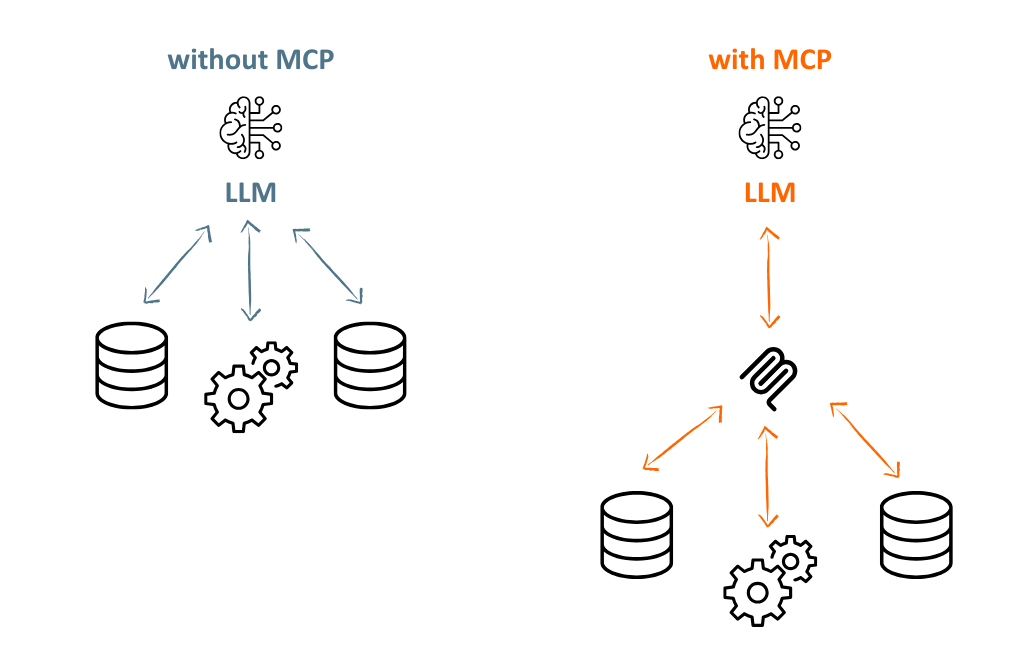 So basically, MCP acts as a communication layer. It defines how agents access tools and resources. For example:
- APIs
- Enterprise systems
- Translation services
- Databases
- Search functions
- RAG retriever
- Individual business logic.
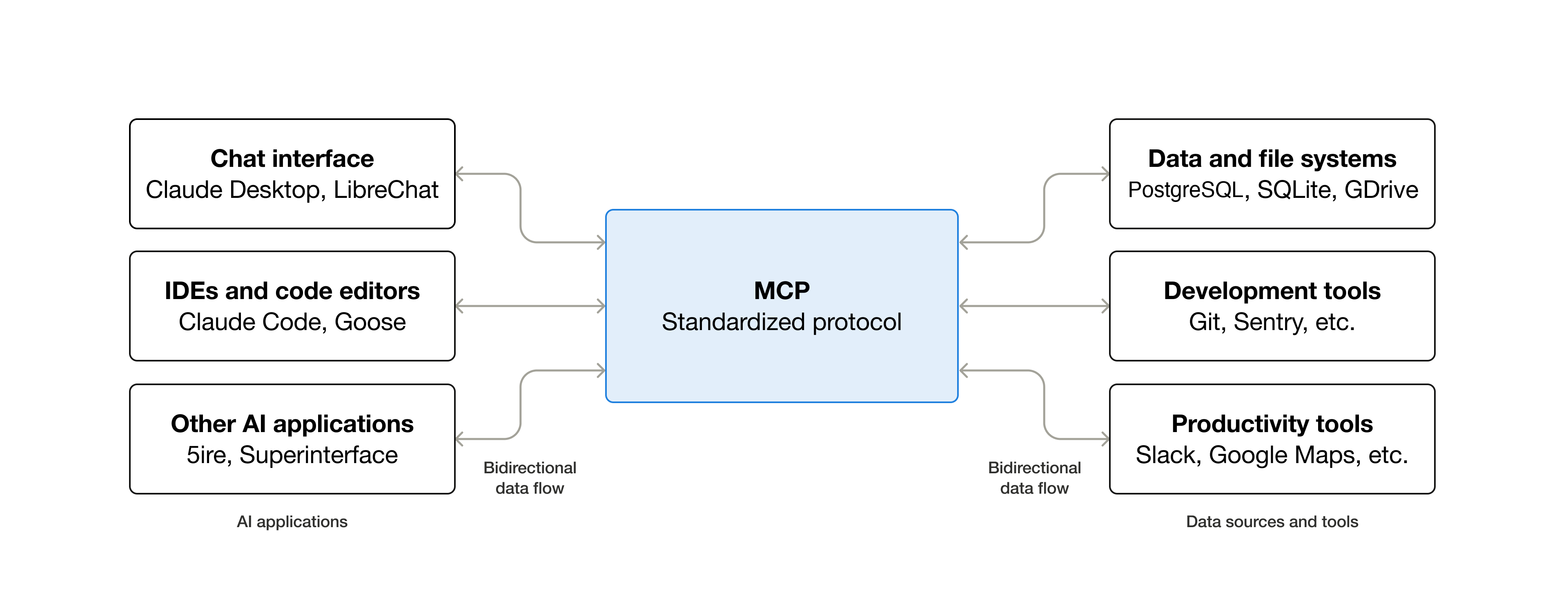
Image source: https://modelcontextprotocol.io/docs/getting-started/intro
No more isolated solutions
Many companies are currently experimenting with different AI models, applications, and data sources. Often individual integrations are created that are difficult to maintain. So instead of connecting each application directly to each system, communication can take place via MCP. This has several advantages:
- Fewer hallucinations, better answers
If models can access current data and specialized tools, they need to guess less. This improves both the quality of the answers and the comprehensibility of the results. - Develop once, use anywhere
A tool only needs to be deployed once as an MCP-compliant service. It can then be used by different agents, models, or applications. - Always up-to-date data
Data can be retrieved live from the source and AI does not have to work with outdated knowledge. - Security and control
Models only have access to the tools or data that is actually needed. All interactions can be logged and tracked. - Clean architecture
MCP clearly separates responsibilities, making systems more flexible and maintainable:- Agent or LLM: Think, infer, and generate text
- MCP: Communication and access level
- Tools: Perform specific tasks
MCP and RAG: Competition or teamwork?
Anyone who has already dealt with AI applications has probably already come across the term RAG (Retrieval-Augmented Generation). RAG extends language models with external knowledge sources, so that responses can be based on current or company-specific information. MCP does not replace RAG – on the contrary. The protocol can help to build RAG architectures cleaner. Instead of individually linking various data sources, specialized retrieval components can be provided as MCP tools. The AI then automatically uses the appropriate tool for the respective data type. This reduces complexity and simplifies maintenance.
Conclusion: Why MCP will probably remain
The AI world is developing rapidly. New models, agents, and platforms appear almost every day. But what has often been lacking so far are common standards. MCP addresses precisely this problem. It provides a unified way to connect models to tools and data sources, regardless of which vendor or model is used. Whether MCP is established as a universal standard in the long term remains to be seen. However, the idea behind it meets a central need for modern AI systems: Models should not have to know everything. They just need to know how to find the right tools.
And if you are wondering if MCP would work for your use case as well, please do not hesitate to contact us and we discuss your possibilities together.