
The use of machine translation (MT) is no longer a far-off idea. But moving from classic human translation with subsequent review to an MT workflow with post-editing (PE) is not a simple system customization. It changes not only the translation approach itself, but also how organizations manage their content, processes, and quality requirements.
Would you like to know how to prepare your translation processes for MT deployment, or are you still unsure which system to choose? Get in touch with us – we will support you with our expertise at every step towards an efficient MT workflow!
The shift has already begun
Many organizations start with the expectation that MT will save time and money. In practice, however, it becomes clear that without a well-thought-out adaptation of existing workflows, new challenges arise – from unclear quality requirements to inefficient processes, inconsistent content and frustration among all parties involved.
At the same time, the technological possibilities are already evolving: In addition to classic MT, Large Language Models (LLMs) are also becoming increasingly important and are expanding the possibilities of modern translation workflows.
So, the real change lies not only in the technology itself, but also in the way it is integrated into existing structures.
Why the shift is more complex than expected
At first glance, the transition seems simple: activate MT, introduce post-editing and you’re good to go. A common misconception as a functioning MT workflow does not arise automatically by simply adding the MT feature.
It requires clear decisions: does my existing system fit, do I just want to introduce classic MT and/or LLMs – and in which stage of the process? What content is suitable for MT? Which quality standards and pricing rules apply? And how do existing processes and skills need to be adapted?
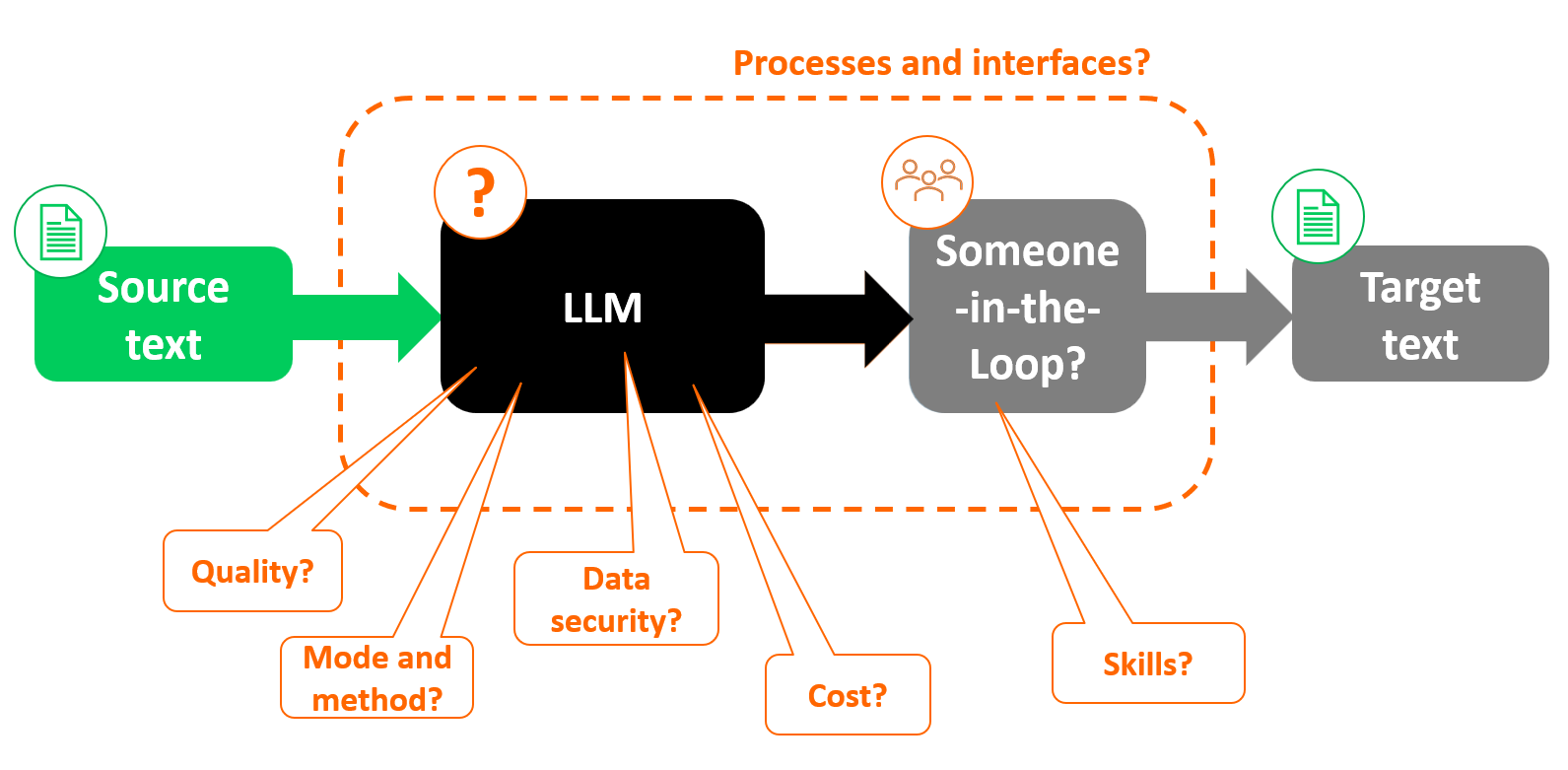
Without answers to these questions, many companies quickly fall into a gray area. Content is processed inconsistently, quality expectations are diverging, and roles remain unclear.
What is really changing in the company
System & Technology: Is my setup MT-ready?
The transition to MT begins with defining the appropriate technical setup. Many modern translation management systems (TMS) already offer integrated MT or LLM components. Alternatively, external engines or applications can be connected via APIs.
The decisive factor is not only the technology itself, but also the strategy behind it: is a generic MT engine sufficient or is there enough good data available to train your own engine and thus get even more out of the MT integration?
Content & Quality: What is suitable for MT at all?
Not all content is suitable for MT. Content with high volumes and short throughput times is particularly popular. Likewise, texts with low stylistic complexity, such as internal documentation or support texts, are often seen MT candidates.
However, legally sensitive content, security-critical documents or texts with a strong brand focus are less suitable, as tonality and precision are crucial.
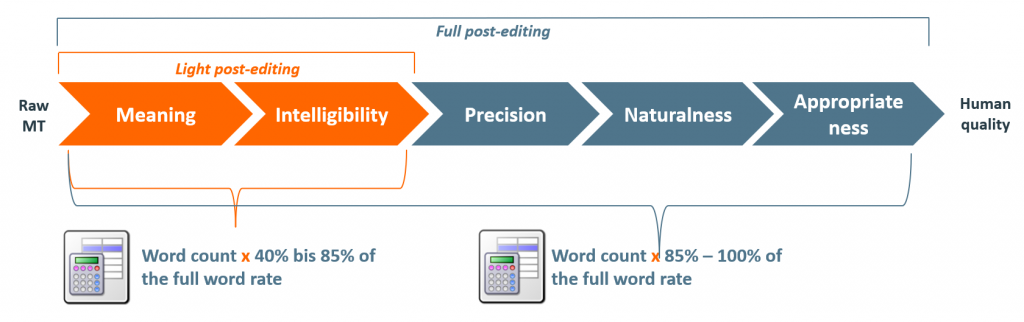
Building on this, quality requirements and pricing structures must also be redefined. Since processing effort in the MT workflow shifts in comparison to a human translation, classic price models cannot be easily transferred. Instead, a percentage of the original word price is calculated – depending on the content type and scope of post-editing – for example, in the context of light or full post-editing.
Processes & Skills: what changes in everyday life?
With the use of MT and LLMs, existing processes are also changing. Instead of traditional workflows with human translation, a combination of translation memory, MT and advanced AI is created. Terminology data should be actively integrated, for example as MT glossaries.
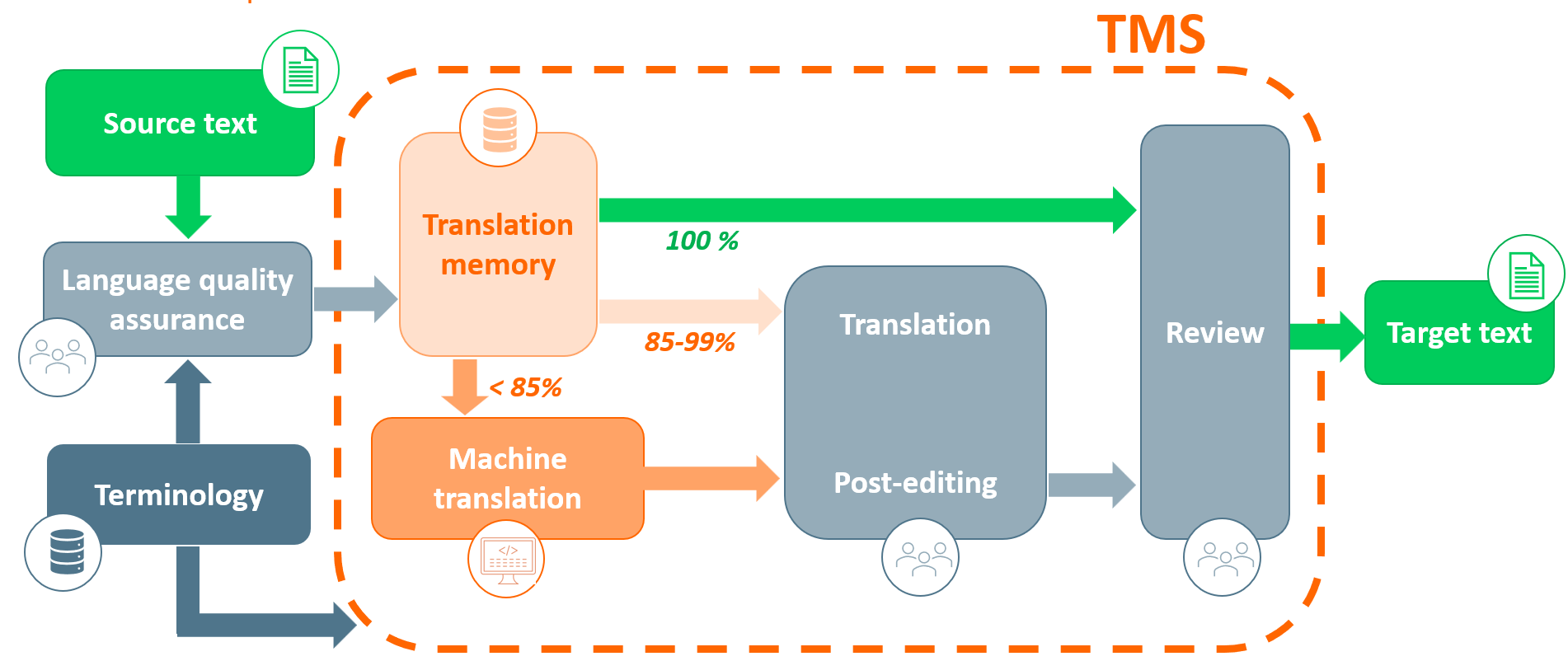
At the same time, the role of stakeholders involved is shifting. Reviewers become post-editors. In addition to the familiar linguistic and cultural skills, new areas of expertise are growing in importance – especially in dealing with MT and AI systems, error assessment and prioritization of corrections needed.
It is precisely this difference between classic review and post-editing that is crucial to the success of an MT workflow.
The shift from reviewer to post editor
At first glance, review and post-editing are similar: In both cases, a text is adjusted to ensure quality. But the objectives and approach are fundamentally different.
Classic review checks and corrects a version that has already been completely translated by a human. The focus is on linguistic fine-tuning, style and consistency – with the aim of creating the highest possible quality, almost perfect target text version.
Post-editing, on the other hand, is based on a different principle. Here, MT provides an initial translation proposal, which is then specifically edited. The goal is not perfection at all costs, but a defined quality level that corresponds to the respective use case or target audience – often with a focus on efficiency and sufficient comprehensibility.
This difference has a direct impact on the way people work: post-editors work more prioritized, systematically assess errors and decide specifically which adjustments are really necessary. Both linguistic and technical aspects play a role, such as the understanding of MT-typical errors and their systematic correction.
Typical obstacles
Even with a clear approach, shifting to an MT workflow poses challenges.
Particularly, company oder team-wide expectations must be mentioned here. MT is often introduced with the expectation of making existing processes more efficient and cost-effective while keeping them largely unchanged. In fact, however, the deployment requires a conscious rethinking – especially in terms of process, effort distribution, responsibilities and quality.
In addition, there is often insufficient internal coordination: if stakeholders are not involved early on or teams are not trained accordingly, this quickly leads to uncertainty and resistance in the change process.
For example, on the side of translators: not all linguists accept the switch to post-editing without reservations.
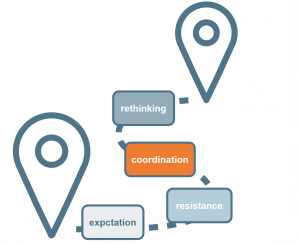
Topics such as changing work methods, reduced creative freedom or uncertainty about one’s own role can make the introduction more difficult.
These points make it clear that the switch to MT or LLM-based processes is not a purely technical project. It requires a clear direction, agreed expectations and a clean integration into existing structures – otherwise the potential will remain unexploited.
What is left now?
MT has long been more than a technological trend – it is changing the way companies think and shape translation processes.
At the same time, the industry is already evolving even further. Machine translation with classic post-editing is now an established standard – but new approaches such as the integration of LLMs significantly expand the possibilities. Whether as support in post-editing, for automated quality steps or in hybrid workflows with “human in the loop”: LLMs enable additional automation and new forms of quality assurance.
It is crucial to find the right balance between automation and human expertise. Depending on the application, the combination of MT, LLMs and targeted human intervention can represent the optimal workflow.
We are happy to help!
If you are currently facing the decision to integrate MT into your processes or to further develop existing workflows, taking a structured look at your current situation is worthwhile.
We are happy to support you in identifying the appropriate approach, integrate MT and new technologies such as LLMs into your processes in a targeted and efficient manner.